
The Paradox of Reality: Are We Living in a Holographic Universe?
What is reality, really? Why do we seem to be the only ones out here? If logic and metaphysics both suggest that it is statistically improbable for us to be alone in the universe—then where is everyone?
These questions have haunted the minds of scientists, philosophers, and mystics for centuries. As I journey through the realms of consciousness with Portal to Ascension, exploring dimensions and the nature of physical reality, I have arrived at a profound realization: we are both here and not here at the same time. We exist in a paradox—where reality is real, yet it is also not real. Time does not exist, yet we experience it.
It’s as if we’ve been living in a perpetual Twilight Zone—a place where quantum physics, quantum computing, and subatomic exploration have begun unraveling the fabric of our understanding. The fundamental building blocks of our reality do not behave according to Newtonian physics. Instead, they operate in a way that seems almost illogical, as if governed by a hidden order we have yet to fully grasp.
The Quantum Conundrum: A Reality of Frequency and Code
If our universe is composed of frequency, energy, and mathematics—all of which follow paradoxical rules—then what does that make us? Are we biological machines embedded with consciousness? Are our bodies some form of intelligent, self-aware code, navigating a dimensional construct?
Consider a computer hard drive: it stores data, programs, and documents. When we open a file, it appears on a screen as something tangible, something we can interact with. But if we physically dismantle the hard drive, we don’t find the actual files—we find circuits, chips, and wiring. Similarly, when we break down our perceived reality, we do not find “solid” matter; we find vibrating energy, probability fields, and quantum uncertainty.
The double-slit experiment is a striking example of this paradox. Subatomic particles behave as both waves and particles, existing in a state of infinite potential until observed. The moment we direct our attention toward them, they “collapse” into a defined state—a single probability in a sea of infinite possibilities.
This suggests that consciousness itself plays a fundamental role in shaping reality. If observation influences the behavior of particles, then are we, in essence, programmers of our own reality? Could it be that we are unconsciously shaping the world around us by our very perception of it?
The Missing Metaphysics in Science
Despite these groundbreaking discoveries, mainstream science often approaches quantum mechanics from a purely materialistic perspective—focusing on computation, technology, and theoretical physics, while avoiding the deeper metaphysical implications.
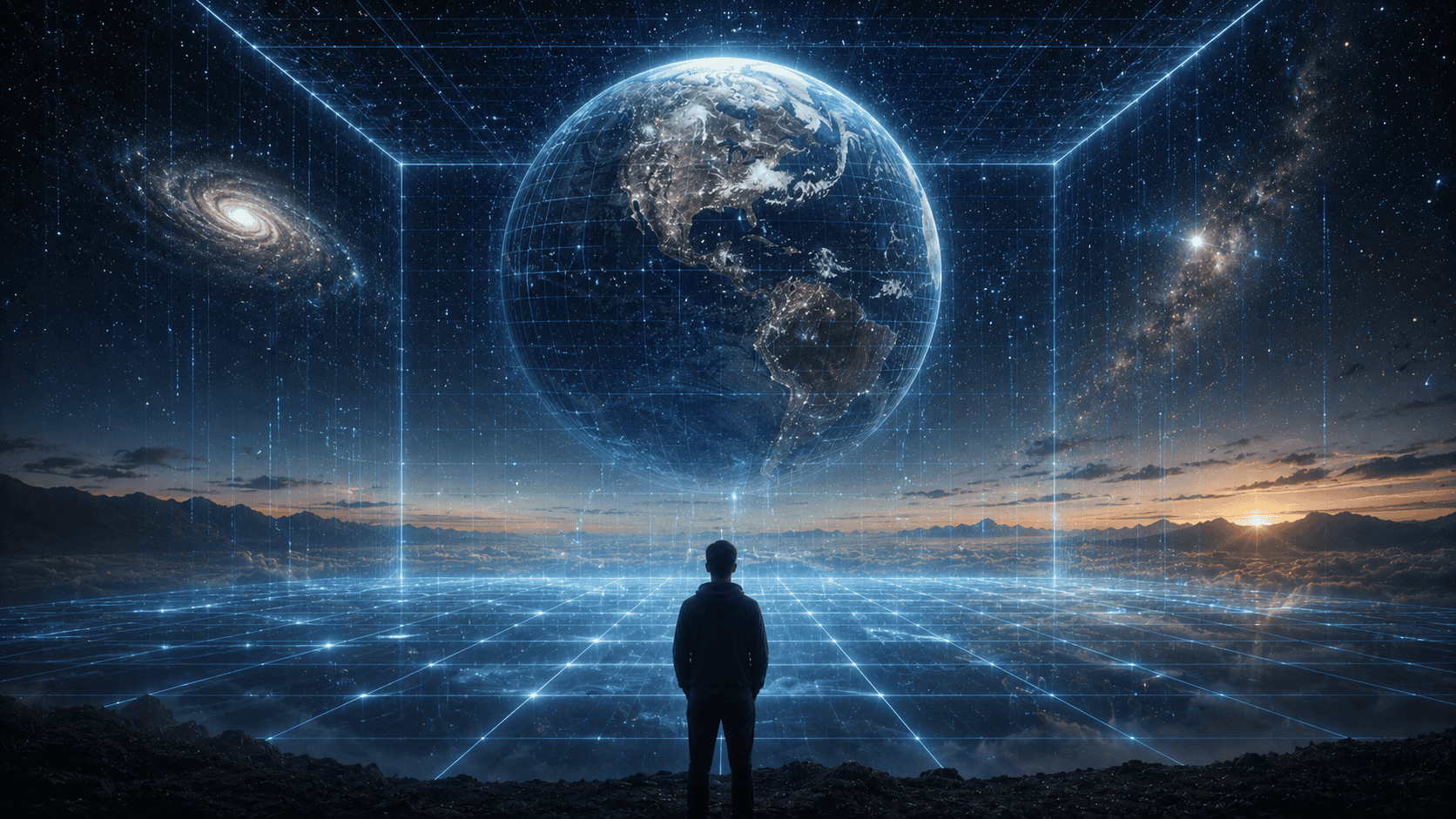
If reality is not as solid as we once believed, then what does that mean for our perception of existence? Are we living inside a highly sophisticated holographic simulation—one that we can navigate, influence, and evolve within? If the foundational fabric of our world is responsive to consciousness, then what are the limits of human potential?
These are the questions we must dare to ask. We are at the precipice of understanding the true nature of reality—not just as passive observers, but as active participants in an unfolding cosmic revelation.
So, I ask again: are we living in a holographic reality—one that appears real only because we are programmed to engage with it as such?
Perhaps, as our understanding deepens, we will learn not only to decode the system but to rewrite it entirely.
Find out more about other dimensions realities at The Real Disclosure Conference
By Neil Gaur